Loading...
HOME2023-01-22T13:43:33-07:00

Damn, there is so much great knowledge out there. Did you know that “BOOKS” are full of smart?? No, I mean like life changing, I-wish-I-knew-that-years-ago type stuff.

I know that I was waaaayyy late to the game figuring it out. And I know that a lot of you are too busy to read as much as you ‘should’. And that is why you need me.

I still remember how it started for me. It started in June of 2008. After 11  years …..Click to continue

Mortgage Today (AM) - 03/12/26 {{catlist}}
March 12, 2026
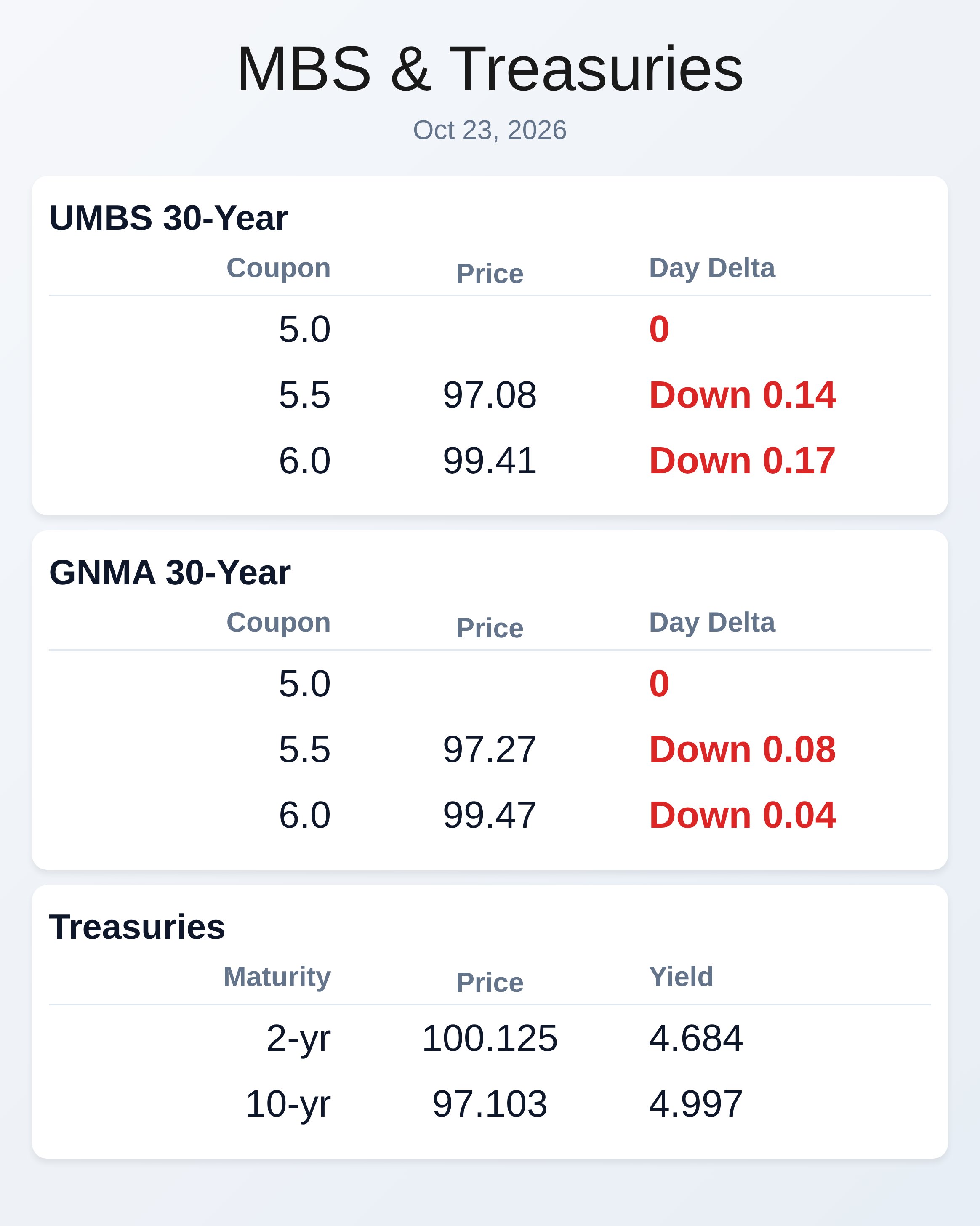
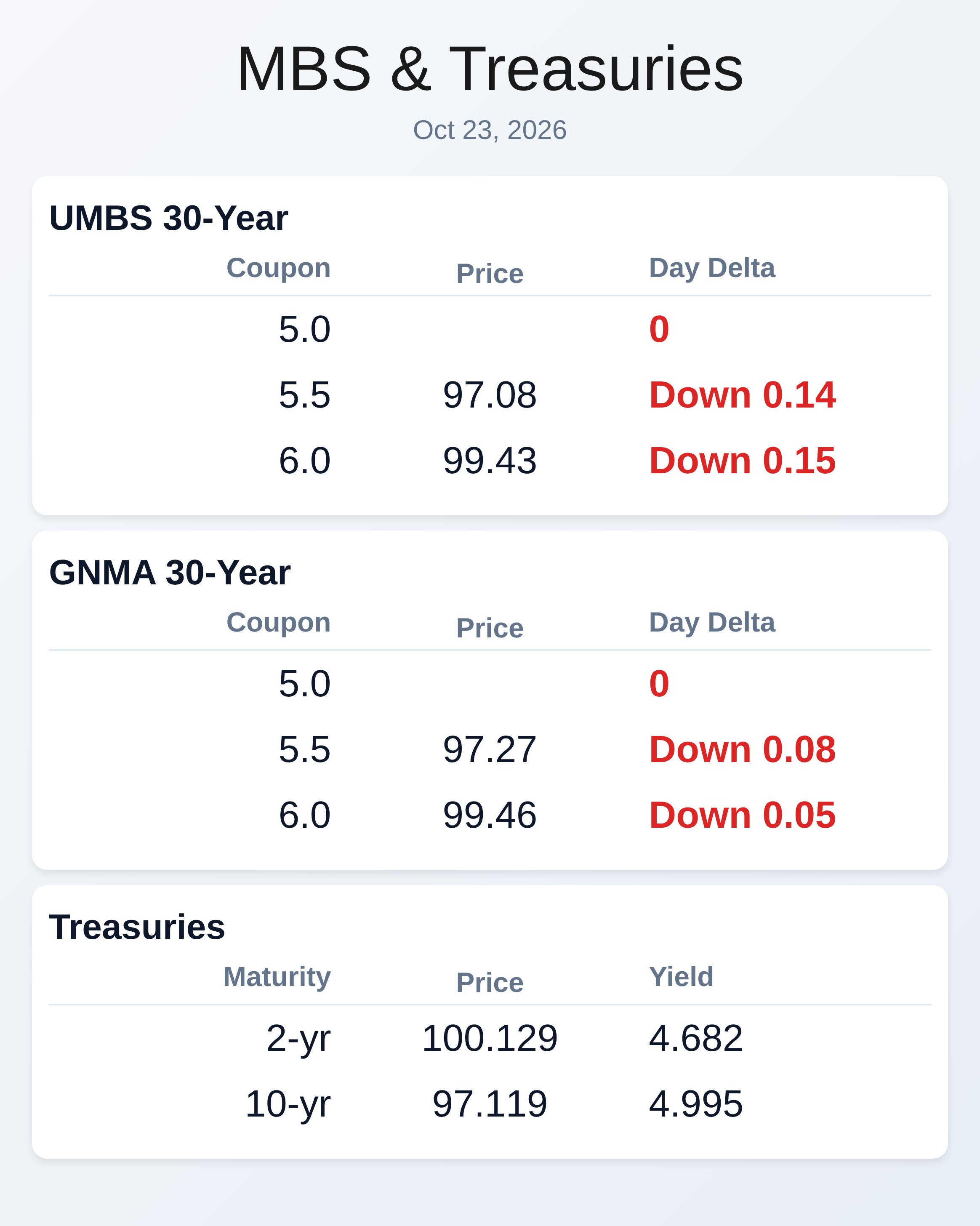
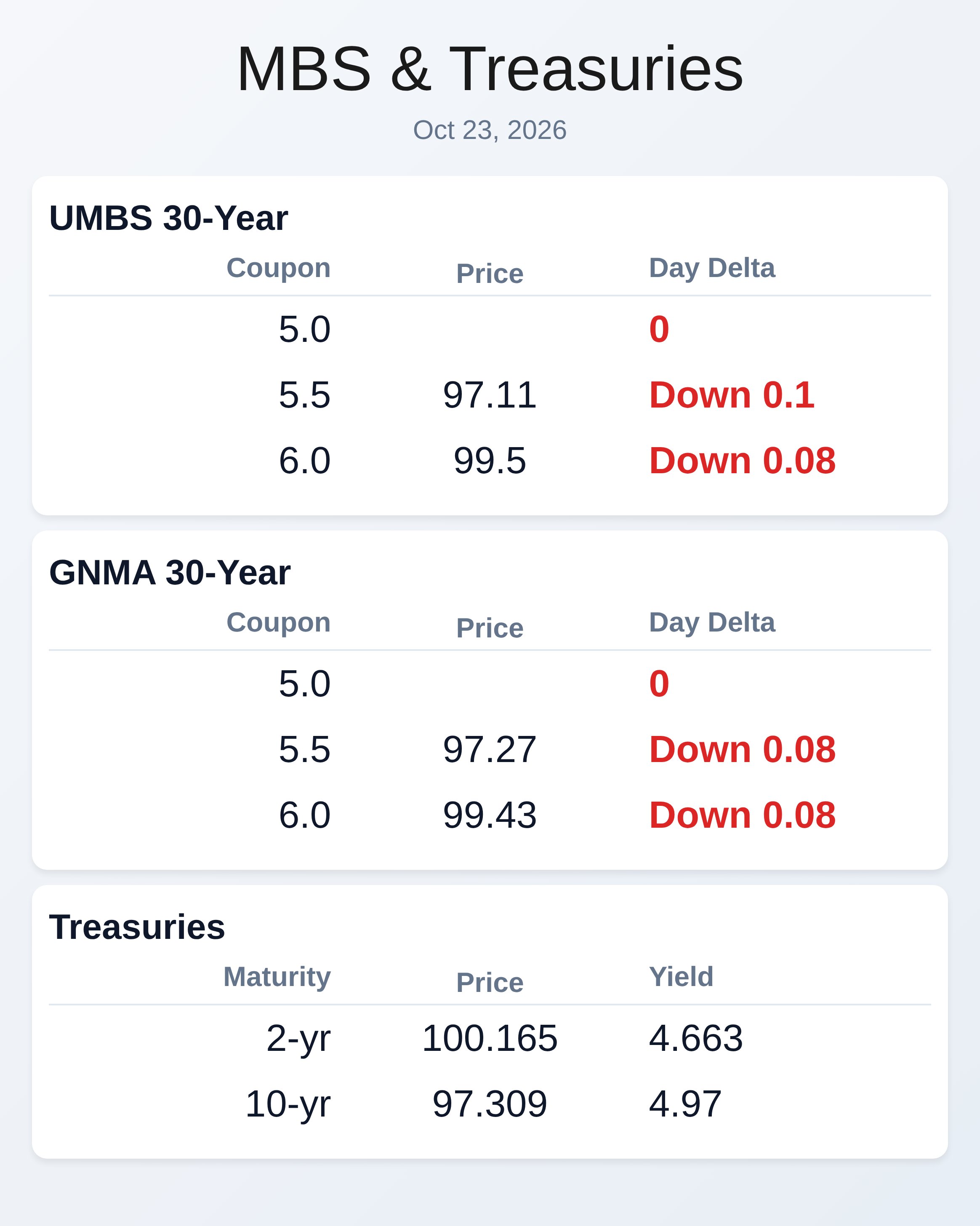
READ MORE WTMS Blog Today = What's up in Mortgage Today (AM) - 03/12/2026 Geopolitical tensions just slammed the mortgage market with MBS dropping an eighth of a point in minutes. President Trump's comments about prioritizing stopping Iran over oil prices triggered immediate bond selling, followed by Iran's Khamenei announcing the Strait of Hormuz should remain closed. UMBS 5.0 coupons fell to 99.15, down 12 ticks, while the 10-year Treasury yield spiked 2.2 basis points to 4.248%. Early-pricing lenders are already eyeing negative reprices as volatility continues to dominate March trading. This morning's economic data painted a mixed housing picture that markets largely ignored amid the geopolitical chaos. Housing starts jumped 7.2% month-over-month to 1.487 million units, beating expectations and showing 9% year-over-year growth. Building permits disappointed at 1.376 million, down 5.4% and missing forecasts. Weekly jobless claims hit 213,000 as expected, while the January trade deficit narrowed significantly to $54.5 billion from $70.3 billion, driven by a surge in exports. Yesterday's rate deterioration felt more severe than typical daily swings due to technical factors in mortgage pricing. The 10-year Treasury yield broke decisively above the closely watched 4.20% level, triggering widespread bond selling that hit MBS even harder than Treasuries. Many mortgage securities are trading near par value, meaning their pricing relies heavily on interest-only valuations that amplify rate movements when markets shift quickly. The widening spread between MBS and Treasury prices forced lenders to reprice for the worse to protect margins. Oil prices are driving inflation concerns as crude has surged 25% since late February amid the Iran conflict. The February CPI report offered no relief on inflation, coming in as expected and reinforcing that disinflationary progress has stalled. Core Personal Consumption Expenditure is expected to post another solid 0.4% monthly gain when it prints tomorrow. Despite inflation pressures, the Federal Reserve is still expected to deliver two modest rate cuts later this year while focusing primarily on energy dynamics and geopolitical risks. March has been relentlessly bearish for mortgage rates with yields climbing across the curve. Treasury yields closed above their 200-day moving averages yesterday after weak demand at a $39 billion 10-year note reopening. Today brings a $22 billion reopened 30-year bond auction and remarks from Fed Vice Chair Bowman on Basel III bank capital rules. The New York Fed will also conduct a buyback operation for $4 billion in 7-year to 10-year coupons to support liquidity. Locking vs Floating Volatility risk remains significantly elevated due to ongoing geopolitical uncertainty surrounding the Iran conflict and potential Strait of Hormuz disruptions. March has delivered consistent selling pressure for rates without any clear signs of leveling off. Given the heightened risk environment and bearish momentum, defensive postures make sense until this negative trend shows clear signs of stabilization. Markets are reacting sharply to headlines, making float strategies particularly risky in the current environment. Today's Events Building Permits (Jan): 1.376M vs 1.41M forecast, 1.455M previous Continued Claims (Feb 28): 1,850K vs 1,850K forecast, 1,868K previous Housing Starts (Jan): 1.487M vs 1.35M forecast, 1.404M previous Jobless Claims (Mar 7): 213K vs 215K forecast, 213K previous Trade Gap (Jan): -$54.50B vs -$66.6B forecast, -$70.3B previous Bond Pricing UMBS 30 yr | Coupon | Price | Intra-Day Change | | 5.0 | 99.18 | -0.09 | | 5.5 | 100.82 | -0.06 | | 5.0 | 99.71 | -0.06 | GNMA 30 yr | Coupon | Price | Intra-Day Change | Treasuries | Term | Yield | Price | Intra-Day Yield Change | | 2 yr | 3.67 | 99.676 | 0.019 | | 3 yr | 3.69 | 99.465 | 0.013 | | 5 yr | 3.818 | 99.692 | 0.013 | | 7 yr | 4.018 | 99.893 | 0.011 | | 10 yr | 4.239 | 98.065 | 0.012 | | 30 yr | 4.886 | 95.92 | 0.003 | Market Data
The Pentagon vs. The Programmer: When AI Ethics Meet National Security {{catlist}}
March 11, 2026
READ MORE

The Pentagon vs. The Programmer: When AI Ethics Meet National Security

A major AI company said "no" to helping with lethal warfare. The government’s response? Labeling them a security risk usually reserved for foreign enemies.
 

Imagine you run a bakery. You make great cakes. The local police department loves your cakes and buys them for retirement parties. One day, they ask you to bake a cake containing a hidden surveillance device to catch a criminal. You say, "Whoa, no. I just make cakes; I don’t do police work. My bakery’s policy forbids getting involved in dangerous situations."

The next day, the police chief publicly labels your bakery a "high-risk supplier," using a law meant to stop drug cartels from laundering money through local businesses. Suddenly, nobody wants to buy your cakes because you’ve been branded a security threat.

This is essentially what is happening right now between Anthropic—one of the world's leading Artificial Intelligence companies—and the United States Department of Defense (DoD).

The Dispute: Drawing a Red Line on "Kinetic Warfare"

On March 9, 2026, Anthropic, the San Francisco-based creators of the "Claude" AI models, filed a lawsuit against the Department of Defense. The core of the fight is about what AI should, and absolutely should not, be allowed to do. Anthropic was founded with a heavy emphasis on "AI safety," meaning they build guardrails into their models to prevent them from causing severe harm.

The conflict began when defense contractors working with the Pentagon tried to use Anthropic’s models for tasks related to "kinetic warfare." In military terms, "kinetic" means lethal force—things like helping select targets for bombings, directing autonomous drones to attack, or calculating kill chains. Anthropic pointed to their Acceptable Use Policy, which explicitly forbids using their tech for activities that have a high risk of causing death or severe physical harm. They agreed to help the DoD with things like logistics, data analysis, and intelligence synthesis, but they drew a hard line at direct involvement in lethal operations.

The DoD’s reaction was swift and severe. They utilized a specific legal provision—Section 805 of the Fiscal Year 2024 National Defense Authorization Act (NDAA)—to designate Anthropic's products as a "supply chain risk." This is a massive black mark for any company trying to do business with the government or large corporations. Anthropic argues this designation is retaliation for sticking to their ethical guns and is suing to have it overturned.

The Pentagon’s Perspective: Mission Criticality

To understand the DoD's side, you have to look at the world through the lens of national security. The Pentagon is currently in a technological arms race, primarily with China. They believe that whoever integrates advanced AI into their military fastest will have a decisive advantage for decades. The DoD is under immense pressure to modernize, and they rely heavily on private tech companies to do it.

From the Pentagon's viewpoint, a critical supplier refusing to support vital aspects of a military mission is a supply chain risk. If the military builds its infrastructure around a specific AI tool, and suddenly that tool is unavailable for a crucial combat operation because of company policy, lives could be lost, and missions could fail. The DoD argues they need reliable partners who won't pull the rug out from under them when things get "kinetic."

By using the Section 805 designation, the DoD is essentially flexing its muscles. They are signaling to the entire tech industry that if you want the lucrative contracts that come with government work, you cannot pick and choose which parts of national defense you support. They are using the legal tools available to them to mitigate what they see as a vulnerability in their technological armor.

Anthropic’s Stance: Ethics Aren't a "Risk"

Anthropic’s argument is rooted in both principle and administrative law. First, they argue that being an American company committed to safety is the opposite of a "risk." They believe that preventing AI from autonomously making life-or-death decisions is actually good for humanity and long-term national stability. They are willing to support the US government, just not in ways that violate their core ethical charter against enabling lethal violence.

Legally, Anthropic argues the DoD's action is "arbitrary and capricious." This is legal speak meaning the government acted unreasonably, without proper justification, or out of retaliation. They claim the DoD is trying to bully them into changing their safety policies by threatening their business reputation.

Furthermore, Anthropic points out the absurdity of the tool the government used. The "supply chain risk" designation under this specific law is almost exclusively used to block technology from foreign adversaries—think banning Huawei 5G gear because of fears Chinese spies could use it. Anthropic is a US company headquartered in California. Applying a law meant to protect against foreign espionage to a domestic company over an ethics dispute is, in their view, a massive government overreach.

The "Foreign Adversary" Legal Hook

The most baffling part of this case is the specific legal mechanism the DoD chose. Section 805 of the FY2024 NDAA was designed to give the Pentagon faster ways to kick dangerous foreign technology out of its networks. It focuses on risks arising from goods or services linked to a "covered foreign country" or a "foreign adversary"—categories that generally mean China, Russia, Iran, and North Korea.

Using this statute against a domestic US company seems like trying to fit a square peg into a round hole. The law is meant to prevent foreign governments from sabotaging US equipment or stealing secrets through backdoors in software. There is zero allegation that Anthropic is a front for a foreign power or that their software is compromised by spies.

This looks less like a standard application of law and more like administrative creativity—weaponizing a statute meant for foreign threats against a domestic entity because it was the most convenient "big stick" available. Legal experts will likely argue that Congress never intended this law to be used to resolve ethical disputes between the Pentagon and American corporations. If the DoD can label any US company that disagrees with them a "foreign-style risk," it grants them terrifyingly broad power over the private sector.

What Happens Next?

This lawsuit is just the beginning of what will likely be a long legal slog. In the short term, Anthropic will likely ask a judge for a "preliminary injunction." This would temporarily pause the DoD’s designation while the actual lawsuit plays out, stopping the immediate bleeding of Anthropic's reputation. The government will fight hard to keep the designation in place, arguing that courts should defer to the military on matters of national security.

The stakes extend far beyond Anthropic. This case will set a massive precedent for the entire AI industry. If the DoD wins, it sends a chilling message to other tech giants like Google, Microsoft, and OpenAI: If you build safety clauses into your AI that hinder military operations, the government will crush you. It could force tech companies to choose between their ethical charters and government contracts.

If Anthropic wins, it establishes that private companies have a right to draw ethical lines in the sand, even when dealing with the military, without facing retaliation disguised as national security measures. We can expect this to head toward a major court showdown over the next year, defining the relationship between Silicon Valley and the Pentagon for the AI era.

 
Mortgage Today (AM) - 03/11/26 {{catlist}}
March 11, 2026
READ MORE WTMS Blog Today = What's up in Mortgage Today (AM) - 03/11/2026 Markets shrugged off the February CPI report this morning as inflation came in exactly as expected, with core prices rising 0.2% month-over-month and 2.4% year-over-year. The 10-year Treasury yield climbed to 4.19%, up 3.3 basis points, while UMBS prices held roughly unchanged despite overnight weakness. The muted reaction reflects traders' focus on future inflation risks from the Iran conflict rather than backward-looking February data that predates the recent oil price surge. Mortgage prepayment speeds accelerated sharply in February, jumping 21% month-over-month to a 9.0 CPR as falling rates pushed roughly 20% of conventional borrowers into refinance territory. This marks the highest share of borrowers with refinance incentive since early 2022, particularly concentrated in 5.5% and 6.0% coupon pools. For originators, this means the refi pipeline should stay robust heading into spring, with analysts expecting another meaningful increase in prepayment speeds next month as seasonal factors build. Existing home sales rose 1.7% in February to a 4.09 million annual pace, marking the best affordability conditions since 2022 despite year-over-year sales declining for the third time in four months. The median home price increased just 0.3% annually to $398,000, with inventory edging up to 1.29 million homes and 3.8 months of supply. Purchase mortgage applications jumped 7.8% last week even as rates climbed 10 basis points to 6.19%, suggesting buyers may be rushing to lock before rates rise further amid geopolitical uncertainty. loanDepot relaunched its wholesale lending channel after shutting it down in 2022, this time built on proprietary technology with industry veterans Dan Peña and Matt Mancasola leading the division. The move rounds out the company's multi-channel strategy, though the lender faces mounting legal challenges including a new lawsuit from West Capital alleging illegal compensation practices that violated TILA rules. A separate class-action suit filed last July accuses loanDepot of steering customers into higher-rate loans before its 2021 IPO. TransUnion slashed VantageScore 4.0 pricing to $0.99 per score for mortgage lenders, a dramatic discount compared to FICO's $10 fee for 2026. The pricing war comes as credit report costs have surged up to 50% this year, though VantageScore adoption remains slow since lenders still lack GSE pricing grids tied to the alternative scoring model. Experian followed suit with price cuts last week while simultaneously raising FICO prices by roughly 3%, creating pressure on lenders to evaluate their credit scoring strategies. Bond markets experienced renewed volatility yesterday driven by geopolitical uncertainty and a weak $58 billion 3-year Treasury auction that added to negative sentiment. Selling intensified late in the session after reports emerged that Iran was deploying naval mines in the Strait of Hormuz, raising concerns about potential disruption to global energy flows. The conflicting signals from the Trump administration about the Iran conflict unsettled investors already adjusting to expectations for fewer Fed rate cuts and higher persistent inflation. Locking vs Floating Volatility risk remains elevated due to ongoing geopolitical uncertainty despite today's in-line CPI data. Markets are essentially ignoring February's backward-looking inflation numbers and instead trading on oil price proxies for future inflation reports. For loans closing within 30 days, locking now provides protection against further rate deterioration as the $39 billion 10-year Treasury auction at 1 PM ET could add pressure to yields. Today's Events - February Core CPI: 0.2% month-over-month vs 0.2% forecast, 0.3% previous - February Headline CPI: 0.3% month-over-month vs 0.3% forecast, 0.2% previous - February Core CPI year-over-year: 2.5% vs 2.5% forecast, 2.5% previous - February Headline CPI year-over-year: 2.4% vs 2.4% forecast, 2.4% previous - 1:00 PM: $39 billion 10-year Treasury Note Auction Bond Pricing UMBS 30 yr | Coupon | Price | Intra-Day Change | | 5.0 | 99.5 | 0.02 | | 5.5 | 101.03 | 0.05 | | 5.0 | 99.94 | -0.04 | GNMA 30 yr | Coupon | Price | Intra-Day Change | Treasuries | Term | Yield | Price | Intra-Day Yield Change | | 2 yr | 3.63 | 99.752 | 0.04 | | 3 yr | 3.648 | 99.582 | 0.037 | | 5 yr | 3.774 | 99.893 | 0.032 | | 7 yr | 3.971 | 100.175 | 0.031 | | 10 yr | 4.193 | 98.436 | 0.033 | | 30 yr | 4.833 | 96.72 | 0.039 | Market Data
LATEST ARTICLES

RECENT ARTICLES

Mortgage Today (AM) – 03/12/26

March 12th, 2026|Week In Review|

WTMS Blog Today = What's up in Mortgage Today (AM) - 03/12/2026 Geopolitical tensions just slammed the mortgage market with MBS dropping an eighth of a point in minutes. President Trump's comments about prioritizing stopping [...]

Mortgage Today (AM) – 03/11/26

March 11th, 2026|Week In Review|

WTMS Blog Today = What's up in Mortgage Today (AM) - 03/11/2026 Markets shrugged off the February CPI report this morning as inflation came in exactly as expected, with core prices rising 0.2% month-over-month and [...]

Article Archive

Mortgage Today (PM) – 03/09/26

March 9th, 2026|0 Comments

WTMS Blog Today = What's up in Mortgage Today (PM) - 03/09/2026 Bond markets delivered a wild ride today as geopolitical tensions whipsawed oil prices and mortgage-backed securities. UMBS 5.0 coupons closed up 18 ticks [...]

Mortgage Today (AM) – 03/09/26

March 9th, 2026|0 Comments

WTMS Blog Today = What's up in Mortgage Today (AM) - 03/09/2026 Oil prices are wreaking havoc on mortgage markets this morning as geopolitical tensions in Iran drive crude to $118 before pulling back. UMBS [...]

Mortgage Today (PM) – 03/06/26

March 6th, 2026|0 Comments

WTMS Blog Today = What's up in Mortgage Today (PM) - 03/06/2026 Bond markets delivered a wild rollercoaster ride today as February's jobs report shocked traders with a negative 92,000 print against expectations of a [...]

Mortgage Today (AM) – 03/06/26

March 6th, 2026|0 Comments

WTMS Blog Today = What's up in Mortgage Today (AM) - 03/06/2026 Oil prices are drowning out what should have been a rally day for mortgage bonds. February nonfarm payrolls crashed to negative 92,000 jobs [...]

Mortgage Today (PM) – 03/05/26

March 5th, 2026|0 Comments

WTMS Blog Today = What's up in Mortgage Today (PM) - 03/05/2026 The mortgage trigger lead industry ended today as the Homebuyers Privacy Protection Act took effect. Credit reporting agencies can no longer sell trigger [...]

Mortgage Today (AM) – 03/04/26

March 4th, 2026|0 Comments

WTMS Blog Today = What's up in Mortgage Today (AM) - 03/04/2026 Markets opened with relative calm this morning after recent turbulence rattled traders. UMBS 30-year securities showed modest gains with the 5.0 coupon up [...]

Mortgage Today (PM) – 03/03/26

March 3rd, 2026|0 Comments

WTMS Blog Today = What's up in Mortgage Today (PM) - 03/03/2026 Mortgage bonds staged an impressive afternoon comeback after getting hammered overnight on Middle East tensions. UMBS prices recovered from morning losses of 28 [...]

Mortgage Today (AM) – 03/03/26

March 3rd, 2026|0 Comments

WTMS Blog Today = What's up in Mortgage Today (AM) - 03/03/2026 Mortgage rates are getting crushed this morning as bonds face heavy selling pressure to start the new week. UMBS prices dropped sharply overnight [...]

Subscribe

Send me some brain food

Go to Top